Music Monday: April 28, 2025

Hi, everyone. Welcome to this week’s edition of Music Monday.

(Image found online.  Original source unknown.)

Bread released their second album, On the Waters, in July 1970. The lead single came out three months earlier and became the #1 song in the U.S. for one week on August 22, 1970. The band had six Top Ten hits but this was their only top selling record. It was one of my mother’s favorite songs and she played the 45 so much it actually warped. And I still know every word by heart. A hundred years later, as soon as I hear the opening chords, I am transported back to that time so fast I lose my breath. On the series “Mad Men”, Don Draper likened “nostalgia” to a time machine, taking us to a place where we wish to go again. This song makes me long for a home I no longer have. And I ache for it.

(Image found online.  Original source unknown.)

Welsh musician Pete Ham was best known as the lead vocalist, primary songwriter, guitarist & pianist for the band Badfinger. Their first hit, “Come & Get It”, was written & produced by Paul McCartney as the group was the first band signed to The Beatles’ Apple Records label in 1968.

Other hits followed including “No Matter What” and “Baby Blue” along with “Without You” which was covered by Harry Nilsson in 1971 and became a #1 hit for four consecutive weeks in early 1972. Ham co-wrote that song and was one of an array of guitarists who contributed to George Harrison’s solo album, All Things Must Pass, a year earlier. You would think that a musician’s story that started with an affiliation with The Beatles would have a reasonably happy ending. But that was not the case.

A string of fraudulent business deals by an unscrupulous manager who embezzled the band’s money left Ham distraught and he died by suicide 50 years ago on April 24, 1975, three days before his 28th birthday. I prefer not to acknowledge the date of an artists’ death, but Badfinger’s story is one-if not the saddest (a second member of the band, Tom Evans, also died by suicide in 1983)-in musical history. And their incredible contributions to music-and the price they paid-should be remembered.

Peter William Ham: April 27, 1947 – April 24, 1975.

Top: Badfinger circa 1969 (L-R): Pete Ham, Joey Molland, Mike Gibbins and Tom Evans. Bottom: George Harrison (L) and Ham (R) in the studio in 1971. (Images found online.  Original sources unknown.)

Twenty years ago my favorite episode of VH1’s “Storytellers” aired. Bruce Springsteen took center stage in the installment which was broadcast on April 23, 2005. It coincided with the release of his 13th studio album, Devils & Dust, three days later. He debuted the title track and “Jesus Was An Only Son” during the show. He closed his set with the first track off his 1975 masterpiece, Born To Run, which will be celebrating its 50th anniversary this August.

And forty years ago, Springsteen was one part of the all-star group who formed USA For Africa to record “We Are The World”, a philanthropic single which was a #1 hit for four weeks in the spring of 1985. An album by the same name was released on April 1, 1985 which has a live track by Springsteen. Last year Netflix released the documentary, “The Greatest Night in Pop” which provides a behind the scenes look in the studio during the recording of the charity song.

Bruce Springsteen at the piano during VH1’s Storytellers in April 2005. (Image found online.  Original source unknown.)

Bread: “Make It With You” (1970, written by David Gates).

Badfinger “Day After Day” (1971, written by Pete Ham. Produced by George Harrison and Todd Rundgren).

Bruce Springsteen & The E Street Band: “Trapped” (1985, recorded live at Meadowlands Arena in New Jersey on August 6, 1984, written by Jimmy Cliff).

Bruce Springsteen: “Thunder Road” (live performance on VH1 Storytellers, broadcast date April 23, 2005).

Stay safe & well.

Music Monday: April 21, 2025

Hi, everyone. Welcome to this week’s edition of Music Monday.

(Image found online.  Original source unknown.)

One of the most influential jazz vocalists in history was born 110 years ago. Eleanora Fagan-better known as Billie Holiday or “Lady Day”- was born on April 7, 1915, in Philadelphia, Pennsylvania. An unstable & tumultuous childhood led her to join her mother in Harlem in 1929 where Holiday soon began singing in nightclubs, inspired by the music of Bessie Smith and Louie Armstrong. Ten years later, Holiday recorded what is arguably considered to be the first civil rights protest song, “Strange Fruit”. Her unique interpretation & phrasing on jazz standards & original music helped elevate her recordings and performances to legendary moments. Although she died in 1959 at age 44, she is still considered to be one of the greatest voices in music.

Top: Billie Holiday circa 1947 with her dog, Mister. Bottom: The singer at Carnegie Hall circa 1948. (Images found online.  Original sources unknown.)

Sixty-five years ago on April 14, 1960, Sam Cooke released “Wonderful World”. He co-wrote the song with business owner & music producer Lou Adler and trumpet player extraordinaire Herb Alpert, who went on to become a co-founder of A & M Records in 1962. The track hit the charts by May 1960 and peaked at #12 a month later. If any of you think you have never heard this fabulous song, think again. It plays in the 1978 movie, “Animal House”, underscoring the iconic scene where Bluto (John Belushi) is going through the cafeteria line, then squeezes a chunk of Jell-O into his mouth just before the food fight scene (“That boy is a P-I-G PIG!!!”).

Top: Sam Cooke circa 1960. Middle: Lou Adler (L) and Herb Alpert (R) circa 2010. Bottom: John Belushi as “Bluto” in “Animal House” (1978). (Images found online.  Original sources unknown.)

Today is the last day to cast your vote for this year’s Rock & Roll Hall Of Fame nominees (find the ballot here). While the place has lost so much of it luster over the years given the list of unworthy people who have been inducted, one person who has deserved the honor for decades is Paul Rodgers. The singer-who celebrated birthday #75 last December-and the rest of Bad Company are finally in the running for the Class Of 2025 (and currently in second place in the voting). There have been rumors for years that Rodgers himself wanted no part of the HOF, but according to a Billboard story from February 2025, both he & bandmate Simon Kirke are thrilled to have finally received the nomination.

They were in a group together previously-Free-with Rodgers on vocals & piano and Kirke on drums before forming the Bad Company supergroup in London in 1973 along with Mick Ralphs from Mott The Hoople on guitar and King Crimson’s Boz Burrell (1946 – 2006) on bass. Kirke is the only continuous member of Bad Company in its 52 year history. Their self-titled debut album was released in the UK in May 1974 (a month later in the U.S.). Fifty years ago, the band released their second album, Straight Shooter, on April 2, 1975. The band recorded on Led Zeppelin’s own label, Swan Song Records.

This is a long time coming for the group and Rodgers specifically as his voice became one of the definitive ones in rock music nearly 60 years ago thanks to his tenure in Free (1968-1973, most notably as the co-writer & voice behind their anthem, “All Right Now”), Bad Company (1973-1982, 1998-present), The Firm (1984-1986), his turn with Queen (2004-2009) and numerous solo projects over the years. Maybe now that Bad Company has secured its own nomination, Rodgers’ individual achievements will soon be recognized by the hall as well.

Top: Bad Company circa 1974 (L-R): Boz Burrell, Mick Ralphs, Paul Rodgers, Simon Kirke. Bottom: Kirke, Rodgers and Ralphs circa 2012. Both pictures courtesy of the band’s website. (Images found online.  Original sources unknown.)

Billie Holiday: “All of Me” (1941, written by Gerald Marks and Seymour Simons).

Billie Holiday: “God Bless The Child” (1942, written by Arthur Herzog Jr. and Billie Holiday).

Billie Holiday: “Good Morning Heartache” (1946, written by Ervin Drake, Dan Fisher and Irene Higginbotham).

Sam Cooke: “Wonderful World” (1960, written by Lou Adler, Herb Alpert and Sam Cooke).

Bad Company: “Bad Company” (1974, written by Simon Kirke and Paul Rodgers).

Bad Company: “Shooting Star” (1975, written by Paul Rodgers).

Bad Company: “Rock & Roll Fantasy” (1979, written by Paul Rodgers).

Stay safe & well.
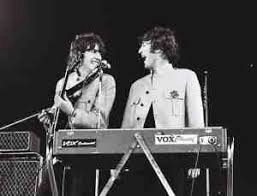
Music Monday: April 14, 2025

Hi, everyone. Welcome to this week’s edition of Music Monday.

(Image found online.  Original source unknown.)

The year 1970 introduced us to the genius that is Elton John. Five years later, he was one of the biggest stars on the planet, with his music-and lyrics by Bernie Taupin-underscoring a number of “wonder years” moments for many of us.

His self titled album was released 55 years ago on April 10, 1970 in the UK. It premiered in the U.S. three months later as his debut album. But in the UK it was his sophomore record after 1969’s Empty Sky (which was not released in the U.S. until 1975 with a new cover design).

(Image found online.  Original source unknown.)

The 1970 release features two of my favorite EJ songs along with “Take Me To The Pilot” and “Border Song”. Later that year on October 30, he released Tumbleweed Connection. Thus began his reign as one of the top talents of the decade.

(Image found online.  Original source unknown.)

In 1975, EJ had several #1 hits (which I highlighted in my February 24, 2025 post). That was also the year he made his acting debut as The Pinball Wizard in The Who’s rock opera, “Tommy”. It premiered 50 years ago on March 19, 1975. Two months later, on May 19, 1975, EJ released Captain Fantastic and the Brown Dirt Cowboy.

Together Elton John and Bernie Taupin brought us one of the greatest, most beloved chapters of music. It remains one of my all time favorites.

Top: Elton John’s 1975 album premiered two months after his acting debut in the movie, “Tommy” (bottom picture). (Images found online.  Original sources unknown.)

Elton John: “Your Song” (1970, written by Elton John and Bernie Taupin).

Elton John: “I Need You To Turn To” (1970, written by Elton John and Bernie Taupin).

Elton John: “Burn Down The Mission” (1970, written by Elton John and Bernie Taupin).

Elton John: “Pinball Wizard” (1975, written by Pete Townshend).

Elton John: “Someone Saved My Life Tonight” (1975, written by Elton John and Bernie Taupin).

Stay safe & well.

Music Monday: April 7, 2025

Hi, everyone. Welcome to this week’s edition of Music Monday.

(Image found online.  Original source unknown.)

The Beatles had the top selling song in the country 55 years ago. The title track from their final studio release, Let It Be, reached #1 on April 11, 1970 for two consecutive weeks.

The album-which debuted a month later on May 8, 1970-also reached the top spot in the U.S. for a month later that year (June 13 – July 10), knocking Paul McCartney’s self titled solo debut from the #1 spot after its three week hold in that position. The release of his own record on April 17, 1970 came one week after he officially announced he was leaving The Beatles, marking the end of what was arguably considered to be the greatest musical group the world had ever seen. Luckily the year ended with the release of another post Beatles solo record: George Harrison’s All Things Must Pass. The first single, “My Sweet Lord” reached the #1 spot on December 26, 1970.

(Image found online.  Original source unknown.)

The Beatles never officially finished Let It Be, however. The final mixing was done by American music producer Phil Spector who took what was known as the “Get Back” tapes and turned it into the band’s last collaborative effort. It produced another top selling song, “The Long & Winding Road”, which hit #1 on June 13, 1970 for two consecutive weeks. Incidentally, an earlier rendition of “Get Back”-credited as The Beatles with Billy Preston (the keyboard extraordinaire who played on the song with them) was released as a single a year earlier and reached the top spot in May 1969 for five consecutive weeks.

A film under the same title as the album, directed by Sir Michael Edward Lindsay-Hogg, was released on May 13, 1970. Most of it features The Beatles in the studio rehearsing the Let It Be songs at the beginning of 1969 and ends with the rooftop concert the band performed on January 30, 1969.

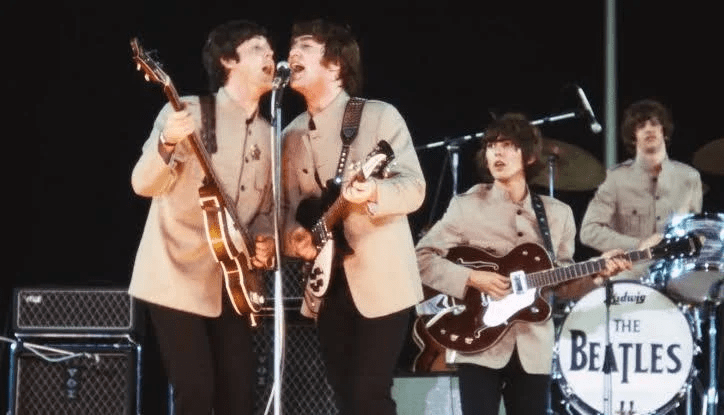
The Beatles performing on the roof of the Apple building in January 1969 (L-R): Paul McCartney, Ringo Starr, John Lennon and George Harrison. . (Image found online.  Original source unknown.)

Many years later, that film became my first real introduction to the band. It was running on a loop on cable during the summer before I started junior high and I watched it every chance I got. I bought the album, read every book I could get my hands on about the group and started my life long obsession with their music.

Despite their official breakup in 1970, there would be a number of Beatles releases after that including Let It Be… Naked, released in 2003. It stripped the Wall Of Sound effects Phil Spector had added so the new album just featured the music we heard all throughout the movie. And 55 years later, both are still testaments to the magic of The Beatles.

(Image found online.  Original source unknown.)

The Beatles: “Two Of Us” (1970, written by John Lennon and Paul McCartney).

The Beatles: “I Me Mine” (1970, written by George Harrison).

The Beatles: “The Long And Winding Road” (1970, written by John Lennon and Paul McCartney).

The Beatles: “Let It Be ” (Naked version, remastered in 2013, written by John Lennon and Paul McCartney).

Stay safe & well.

Music Monday: March 31, 2025

Hi, everyone. Welcome to this week’s edition of Music Monday.

(Image found online.  Original source unknown.)

Trumpeter, songwriter, arranger, producer and band leader Herb Alpert turns 90 today. Born March 31, 1935 in Los Angeles, California, he is also well known as a record executive and businessman, most notably as the co-founder & the “A” in A & M Records, the label he started in 1962 with Jerry Moss (1935 – 2023). In 1989, they sold the company to the Polygram label for 500 million dollars.

Alpert started playing the trumpet as a child. After he served in the army during the Korean War, he began his professional career in music as a songwriter at Keen Records. One of the more well known songs he co-wrote during that period was “Wonderful World”, released by Sam Cooke in 1960. Shortly after that Alpert formed The Tijuana Brass (TJB) which had five #1 albums in the 1960’s.

Top: Herb Alpert in an A&M promotional picture circa 1965. Middle: With Jerry Moss (L) circa 1974. Bottom: With his wife of 51 years, Lani Hall (R), circa 2019. (Images found online.  Original sources unknown.)

One of those top selling records, Whipped Cream & Other Delights, held the #1 spot on the U.S. Billboard 200 album chart for eight weeks. It is also celebrating a milestone this year, as it was released 60 years ago on on April 1, 1965. Renowned as much for the music as its cover which was deemed “racy” for its time due to its cover picture of a woman drenched in-what else-whipped cream, it features “A Taste Of Honey” and covers of the Johnny Mercer jazz standard, “Tangerine”, and the Lieber & Stoller hit, “Love Potion #9”. Alpert followed his tenure with the band with a solo career which included a #1 record in 1979 with “Rise”. He is currently on tour with the TJB celebrating their legacy.

(Image found online.  Original source unknown.)

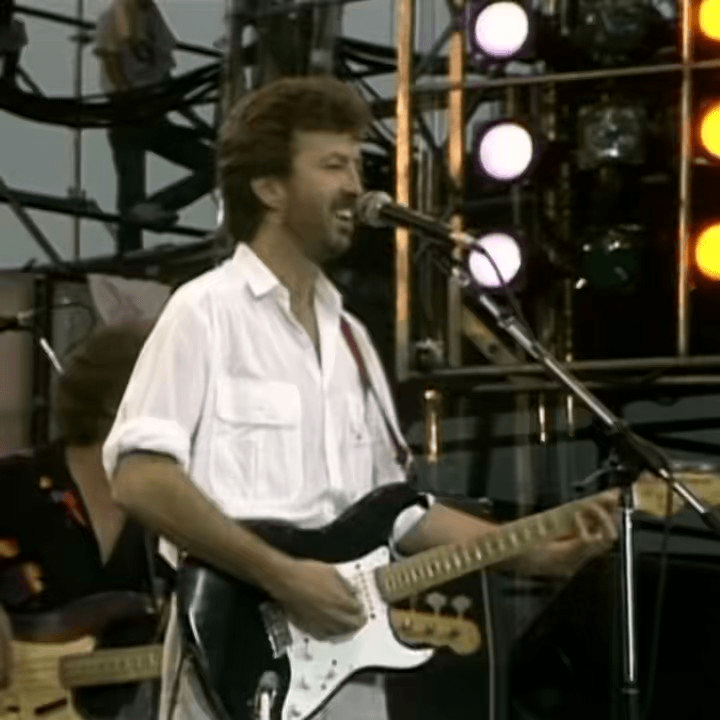
Guitar legend Eric Clapton turned 80 years old yesterday. He was born March 30, 1945 in Ripley, United Kingdom and began playing guitar as a teenager. He joined The Yardbirds in 1963, then left for a short stint with John Mayall & the Bluesbreakers before joining up with drummer Ginger Baker & bassist Jack Bruce in 1966 for the massively successful supergroup, Cream. In 1968 Clapton performed as a guest guitarist for The Beatles on “While My Guitar Gently Weeps”. After the end of Cream, he became a member of Blind Faith and Derek & The Dominos where one of his best known songs, “Layla” was recorded. His solo career followed including top selling albums from the 1970’s through the 1990’s which further secured Clapton’s place as a musical icon. He just announced a few U.S. concert dates for this fall in support of his latest studio album, Meanwhile.

Eric Clapton through the years from the 1960’s (picture 1), the 1970’s (picture 2), the 1980’s (picture 3) & the 1990’s (picture 4). (Images found online.  Original sources unknown.)

Herb Alpert & The Tijuana Brass: “Ladyfingers” (1965, written by Toots Thielemans).

Herb Alpert: “This Guy’s In Love With You” (1968, written by Burt Bacharach and Hal David).

Herb Alpert: “Diamonds” (1987, written by James Harris III and Terry Lewis).

Blind Faith: “Can’t Find My Way Home” (1969, written by Stevie Winwood). (1969, written by Stevie Winwood).

Derek & The Dominoes: “Bell Bottom Blues” (1970, written by Eric Clapton and Bobby Whitlock).

Eric Clapton: “Pretending” (1989, written by Jerry Lynn Williams).

Stay safe & well.

Music Monday: March 24, 2025

Hi, everyone. Welcome to this week’s edition of Music Monday.

(Image found online.  Original source unknown.)

A big album from 1985 turned 40 years old last month. Songs From The Big Chair, the second studio album by British band Tears For Fears, was released in February 1985. It proved to be their breakthrough with two #1 hits: “Everybody Wants To Rule The World” for two weeks in June and “Shout” for three weeks in August, the same month the album took over the top spot of the Billboard 200 for five consecutive weeks.

It helped earn the band-formed in Bath, United Kingdom in 1981 by Roland Orzabal and Curt Smith-and their “synth-pop” sound a place as one of the most successful of the decade. My favorite track from the album was released in June 1985. The video was in very heavy rotation at that time and it is still quite popular, garnering 124 million views on YouTube to date. Orzabal’s evocative vocal and his manner of phrasing the song’s thought-provoking lyrics helped the song peak at #3 in the U.S. in November 1985.

Top: Roland Orzabal (L) and Curt Smith (R) on the cover of their 1985 album. Bottom: The duo circa 2024. (Image found online.  Original source unknown.)

If the milestone anniversary of that album does not make you feel old, try this: “The Breakfast Club” also turned 40 last month. The movie, released in February 1985 as well, told the story of five teenagers spending a Saturday together in their high school’s library for a day of detention who learned a lot more than just a lesson in right and wrong.

Whether you still see yourself as “a brain, an athlete, a basket case, a princess or a criminal”, I do not think there is a more relatable film about teenage angst. The John Hughes classic eventually earned 51 million dollars in box office sales worldwide and produced a theme song that hit the top spot in the U.S. for one week in May 1985.

(Image found online.  Original source unknown.)

Tears For Fears: “Head Over Heels” (1985, written by Roland Orzabal and Curt Smith).

Simple Minds: “Don’t You (Forget About Me)” (1985, written by Keith Forsey and Steve Schiff).

Stay safe & well.

Music Monday: March 17, 2025

Hi, everyone. Welcome to this week’s edition of Music Monday.

(Image found online.  Original source unknown.)

Happy St. Patrick’s Day. In honor of this Irish holiday, I would like to pay homage to one of my favorite bands, U2.

Next year will mark 50 years since they formed in Dublin, Ireland in 1976. Their drummer, Larry Mullen Jr.-born October 31, 1961 in that city-placed an ad on a notice board at the Mount Temple Comprehensive School in Dublin, looking for musicians to form a band. These students responded:

David Howell Evans, lead guitarist, keyboardist & vocalist, who would later change his name to The Edge-born August 8, 1961 in Essex England-but his family relocated to Dublin a year later.

Adam Clayton, bassist, who just turned 65-born March 13, 1960 in England-who moved to Dublin five years later with his family.

Paul David Hewson, n/k/a Bono, lead vocalist, guitarist and primary lyricist, who will turn 65 in two months-born May 10, 1960 in Dublin.

(Image found online.  Original source unknown.)

U2 was signed to Island Records and released their debut album, Boy, in October 1980. More than a dozen albums followed including 1987’s The Joshua Tree, 1988’s Rattle & Hum and 1991’s Achtung Baby. But it was their album released in 2000-All That You Can’t Leave Behind-that sent the group off on their “Elevation” tour in Marc 2001 which would put them front and center in the U.S. to deliver a love letter to the country not long after one of its most devastating tragedies.

U2 performed the halftime show at Superbowl XXXVI in New Orleans on February 3, 2002. Standing on a heart shaped stage, they opened with “Beautiful Day”. As they began their second song, “MLK”, a screen emerged from behind the stage which listed the names of all the victims who died five months earlier on 9/11. By the end of their third song, Bono opened his leather jacket to reveal it was lined with the American Flag. With that, the band clapped for the audience who stood before them-and for those watching from home-in an incredible act of kindness and grace underscored by the healing power of music.

Three unforgettable images from Super Bowl XXXVI in February 2002. Top: U2 on stage during the halftime show (L-R: The Edge on lead guitar, Bono behind the mic on vocals, Larry Mullen Jr. on drums and Adam Clayton on bass). Middle: The names of those who lost their lives on 9/11 were featured on a giant screen behind the band as they started their second song. Bottom: Bono showing America some additional love at the end of U2’s performance. (Images found online.  Original sources unknown.)

U2: ” Where The Streets Have No Name” (1987, written by U2: Bono, Adam Clayton, The Edge and Larry Mullen Jr.).

U2: “One” (1991, written by U2: Bono, Adam Clayton, The Edge and Larry Mullen Jr.).

U2: “Walk On” (2000, written by U2: Bono, Adam Clayton, The Edge and Larry Mullen Jr.).

U2: “Sometimes You Can’t Make It on Your Own” (2004, written by U2: Bono, Adam Clayton, The Edge and Larry Mullen Jr.).

Stay safe & well.
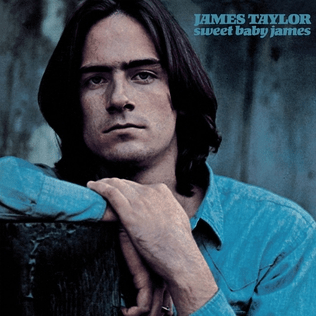
Music Monday: March 10, 2025

Hi, everyone. Welcome to this week’s edition of Music Monday.

(Image found online.  Original source unknown.)

Another of my favorite songs just hit a milestone anniversary. It was written by blue-eyed soul master Daryl Hall and included by he & John Oates on their 1980 album, Voices. Another singer with a smooth R&B sound released it 40 years ago on February 25, 1985 as the first single from his second album, The Secret Of Association. The track reached the #4 spot in the UK a month later and the #1 spot in the U.S. for one week in July of the same year.

British singer, songwriter & musician Paul Young followed that hit with “I’m Gonna Tear Your Playhouse Down” which reached #13, also in 1985. Young first broke into the U.S. Top 40 in February 1984 with “Come Back And Stay” which peaked at #22 off his 1983 debut solo album, No Parlez. Later that year he was chosen as one of the lead voices (and the first one heard) on the charity single by Band Aid, “Do They Know It’s Christmas”. He also performed at Live Aid in London in 1985.

In 1990, Young reached the #8 spot in the U.S with a cover of The Chi-Lites #1 hit from May 1972, “Oh Girl”. Another cover-this one of Jimmy Ruffin’s 1966 classic, “What Becomes Of The Brokenhearted”-peaked at #22 for Young in 1992. A year later, he joined Elton John on his Duets album for a cover of “I’m Your Puppet”. To date Young has released 10 albums including 2023’s Behind The Lens.

Paul Young circa 2019. (Image found online.  Original source unknown.)

Paul Young: “Everytime You Go Away” (1985, written by Daryl Hall).

Stay safe & well.
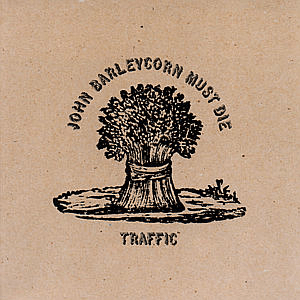
Music Monday: March 3, 2025

Hi, everyone. Welcome to this week’s edition of Music Monday.

(Image found online.  Original source unknown.)

Marianne Faithfull died on January 30, 2025 at age 78. She began her musical career as a folk singer in 1964. When she met The Rolling Stones the same year at a party, their manager gave her one of their newly written songs to record which was the first of a series of hit singles for her. A relationship with Mick Jagger followed from 1966-1970 and while she proved to be a muse for him, her life became tainted by substance abuse which led to a decline in both her personal & professional lives. Her 1979 album, Broken English, started a career comeback with with more albums to follow along with acting roles on stage, TV and in movies.

Marianne Faithfull: December 29, 1946 – January 30, 2025.

Marianne Faithfull circa 1967. (Image found online.  Original source unknown.)

Jerry Butler died February 20, 2025 at age 85. He was the last surviving original member of The Impressions but left them in 1960 to pursue a solo career. In addition to his rich baritone voice, he also co-wrote several songs including “I’ve Been Loving You Too Long” with Otis Redding (who recorded it in 1965 for his Otis Blue album), “Only The Strong Survive” and “Never Give You Up” with Philly Soul superstars Kenneth Gamble and Leon Huff. The former is also the title track to Bruce Springsteen’s 2022 album of soul classic covers. The latter was a hit for Butler in 1968 & covered by The Black Keys for their 2010 album, Brothers. Their version is also featured on the soundtrack for the British crime thriller, “Luther” (S3 E4). Despite his tenure on the Cook County Board of Commissioners in Illinois from 1985-2018, Butler stayed active in music where he served as the chairman of the board for the Rhythm and Blues Foundation.

Jerry Butler: December 8, 1939 – February 20, 2025.

Jerry Butler performing in the 1970’s.(Image found online.  Original source unknown.)

Roberta Cleopatra Flack died on February 24, 2025 at the age of 88. She was born February 10, 1937 in Black Mountain, North Carolina. She started singing in church as a child and began formal piano training at age nine. In the 1970’s she was known for her own work which led to her becoming the first artist to win Record & Song Of The Year back to back at the Grammy Awards in 1973 & 1974.

That decade also gave her success with a few of her duets with Donny Hathaway in the (“Where Is The Love” was a #5 hit in August 1972 and “The Closer I Get To You” peaked at #2 in May 1978), later with Peabo Bryson (“Tonight, I Celebrate My Love” was a Top 20 hit in November 1983) and Maxi Priest (“Set The Night To Music” peaked at #6 in 1991). In 1996, The Fugees cover of “Killing Me Softly”-a #1 hit for Flack for five non-consecutive weeks in 1973- brought attention back to the original recording. In 1974 she received her third #1 song with “Feel Like Making Love” which topped the chart for one week in August 1974.

But it was the placement of one of Flack’s songs in 1971’s “Play Misty For Me”-the directorial debut by Clint Eastwood-that was not only an incredible moment in cinema but led to her first #1 song. It held the top spot for six weeks in the spring of 1972, yet it was originally released on her 1969 album, First Take. I was today year’s old when I found out she did not write that song as I always thought she did. It was written in 1957 by British singer-songwriter Ewan MacColl, the stage name for James Henry Miller. But Flack’s interpretation, her slow, easy yet powerful vocal placed perfectly in an incredible film gave the track and the artist the attention both so richly deserved.

Roberta Flack: February 10, 1937 – February 24, 2025.

Roberta Flack performing in the 1970’s. (Image found online.  Original source unknown.)

Yesterday marked the 75th birth anniversary for the beautiful & unbelievably talented Karen Carpenter. She was born in New Haven, Connecticut on March 2, 1950 and moved with her family to Downey, California when she was a teenager so her brother, Richard, could pursue a career in music. When she joined him as a drummer in his trio, he discovered her sublime voice. It was that sound along with his producing and arranging skills that catapulted them to stardom as a duo in the 1970’s.

There is a story I have read on several sites that mentions a time Karen crossed paths with John Lennon at a restaurant in Los Angeles, California and he told her that he loved her voice. Rumor has it that as flattered as she was, Karen did not believe it as she never realized how supremely gifted she was. The song I have chosen to honor her with today has amassed 67 million views on YouTube. And that is only one platform and only one song from the string of hits she put her vocals to. That is the staggering magnitude of her talent.

Karen Carpenter: March 2, 1950 – February 4, 1983.

Karen Carpenter in the 1970’s. (Image found online.  Original source unknown.)

Marianne Faithfull: “As Tears Go By” (1964, written by Mick Jagger, Andrew Loog Oldham and Keith Richards).

Jerry Butler & The Impressions: “For Your Precious Love” (1958, written by Arthur Brooks, Richard Brooks and Jerry Butler).

Roberta Flack: “The First Time Ever I Saw Your Face” (1969 & 1972, written by James Henry Miller, stage name Ewan MacColl).

The Carpenters: “Rainy Days & Mondays” (1971, written by Roger Nichols and Paul Williams).

Stay safe & well.
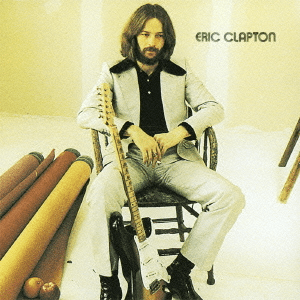
Music Monday: February 24, 2025

Hi, everyone. Welcome to this week’s edition of Music Monday.

(Image found online.  Original source unknown.)

Several now classic and legendary songs hit the top spot on the Billboard Hot 100 charts 50 years ago. This week I am focusing on three of my favorite #1 songs of 1975 – Part 1.

The year started with Elton John in the top spot for two weeks with his cover of a 1967 Beatles song. One of the song’s co-writers-John Lennon, billed on the cover track as “Dr. Winston O’Boogie”-played guitar and contributed backing vocals to it. The two artists collaborated on Lennon’s song, “Whatever Gets You Through The Night” in 1974. It became a #1 hit on November 16 that year, a feat John predicted would happen. That forced Lennon to settle a bet by appearing on stage at John’s concert at NYC’s Madison Square on Thanksgiving night on November 28, 1974 where the two performed that song & a cover of The Beatles’ “I Saw Her Standing There”.

John ended the year with two other #1 songs: “Philadelphia Freedom” hit the top spot for two weeks in April & “Island Girl” was #1 for three weeks in November 1975. He also provided backing vocals on Neil Sedaka’s song, “Bad Blood”, which was #1 for three weeks in October that year. That same month, John became godfather to Lennon’s second son, Sean. 1975 was one of several outstanding years for Elton John.

Elton John (L) and John Lennon (R) on stage at NYC’s Madison Square Garden on November 28, 1974. (Image found online.  Original source unknown.)

The next song to hit #1 in 1975 was by Barry Manilow. The first top selling record of his career reached that position for one week on January 18. Two more #1 records would follow for him over the years along with 11 Top Ten hits to add to his previous success as a jingle writer, a theme song writer & a pianist for The Divine Miss M, Bette Midler. I love a couple of other songs by him-“Weekend In New England” and “Trying To Get The Feeling”, specifically-but Manilow’s #1 track from 1975 had me from the line, “You kissed me and stopped me from shaking”.

Barry Manilow’s second album was released in October 1974. (Image found online.  Original source unknown.)

On February 15, 1975 Linda Ronstadt took over the #1 spot for one week with a track from her fifth album, Heart Like A Wheel. That proved to be her breakthrough record, as it reached #1 on the Billboard Albums chart the same day her cover of the 1963 song by Dee Dee Warwick (sister to Dionne) gave Ronstadt the biggest selling song of her career. Ten Top 10 hits would follow in the next several decades as she successfully explored a number of different genres of music, but 1975 was the year Ronstadt broke through as one of the industry’s greatest talents.
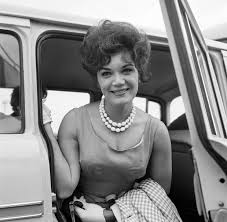
Today’s Linda Ronstadt’s song is from her fifth album, released in November 1974. (Image found online.  Original source unknown.)

Elton John: “Lucy In The Sky With Diamonds” (1974, written by John Lennon and Paul McCartney).

Barry Manilow: “Mandy” (1974, written by Scott English and Richard Kerr).

Linda Ronstadt: “You’re No Good” (1974, written by Clint Ballard Jr.).

Stay safe & well.